
In 2026, DeFi lending is no longer chained to the over-collateralization model that kept it out of reach for many. On-chain credit scores from protocols like Nomis and ORBT are flipping the script, assessing wallet behavior to enable under-collateralized loans and open doors for everyday users. Picture this: instead of locking up 150% or more in crypto just to borrow, your transaction history, repayment track record, and even social proofs on blockchain speak for your creditworthiness. DeFi outstanding loans surged 37% in 2025, fueled by real-world asset tokenization and institutional yield hunger, and now on-chain credit scores are accelerating that momentum into 2026.
This shift addresses a core pain point. Traditional credit scoring leaves millions bankless folks in the dust, but crypto credit scoring in DeFi flips that by analyzing verifiable blockchain data. No more FICO-style black boxes; everything's transparent and tamper-proof. Galaxy's latest update highlights on-chain prime infrastructure as key to institutional adoption, while Orochi Network pegs private on-chain credit as a trillion-dollar play. It's pragmatic evolution: lenders get better risk signals, borrowers gain access without dumping their stacks.
Why Over-Collateralization Held DeFi Back
Early DeFi money markets like Aave or Compound demanded hefty collateral to mitigate smart contract risks and volatility. Borrow USDC? Pledge ETH worth twice as much. Fine for whales, brutal for retail. This locked out genuine users with solid on-chain reps but thin liquidity. Fast-forward to 2026: protocols integrate Web3 credit assessments to slash those ratios. Block3 Finance nails it, a DeFi credit score mirrors wallet reliability through lending history, swaps, and protocol interactions.
Market whispers from DAS New York panels and OAK Research experts point to on-chain lending as the new benchmark. Traditional scores fail the unbanked; DeFi fills the void with blockchain reputation protocols. Institutional infrastructure-first vibes, per Columbus Dispatch, solidify this. Lenders now eye under-collateralized products, especially with RWA yields drawing big money.
Nomis: Reputation That Pays Off in DeFi
Nomis stands out with its Web3Social Score, mintable as an NFT proving your on-chain vibe. It scans wallet trust, social activity, and multi-chain reps to weed out bots from builders. Projects love it for targeted rewards, genuine users get airdrops, loans, or perks without sybil attacks muddying the waters. On Base and beyond, Nomis score Base integration lets lenders gauge if you're a long-term player or flash-in-the-pan.
Think of Nomis as your decentralized LinkedIn for finance. It evaluates engagement depth: consistent liquidity provision? Points up. Serial bridger across chains? Trust boost. In practice, this powers undercollateralized lending, where a high score might drop collateral needs to 120% or less. Users mint, share, and lenders plug in, seamless. No wonder it's fueling 2026's DeFi inclusivity push.
ORBT: Liquidity Aggregation for Credit Efficiency
ORBT takes a different angle, uniting fragmented liquidity while scoring on efficiency, solvency, and real settlements. This ORBT DeFi score routes capital smartly across lending, perps, and more, juicing capital utilization. Forget siloed pools; ORBT's unified layer means lenders deploy funds optimally, backing under-collateralized loans with data-backed confidence.
Chainlink's take on on-chain private lending aligns here, extending credit sans 150% collateral to institutions via blockchain. ORBT's metrics shine for risk managers: does this wallet settle trades promptly? Solvency strong? Efficiency high? Green lights for loans. Crypto Adventure's 2026 picks emphasize mature markets with tight controls, and ORBT fits, enhancing liquidity depth for safer, scalable borrowing.
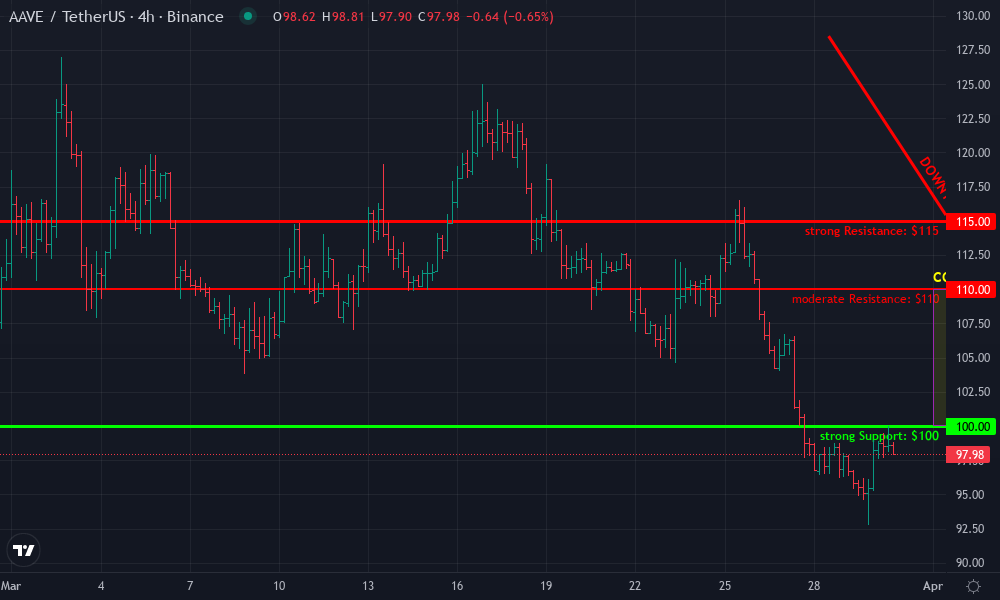
Aave Technical Analysis Chart
Analysis by Dylan Travers | Symbol: BINANCE:AAVEUSDT | Interval: 1D | Drawings: 5
Technical Analysis Summary
As Dylan Travers, apply conservative overlays: Draw a primary downtrend line from the March 28 peak at 128 connecting to April 5 low at 102 (red trend_line, thick). Add horizontal support at 100 (green horizontal_line, strong). Mark resistance at 115 (red horizontal_line). Use fib_retracement from March high 130 to April low 100 for pullback levels. Rectangle consolidation zone 100-110 from April 1-10. Callout volume divergence at recent lows. Arrow up on MACD histogram fade. Text risk warning: 'Low risk tolerance - wait for 110 break'.
Risk Assessment: medium
Analysis: Short-term downtrend intact but support holding with positive DeFi lending macro; low tolerance favors scaled entries
Dylan Travers's Recommendation: Hold cash or small position; monitor for 110 break with on-chain metrics confirmation
Key Support & Resistance Levels
📈 Support Levels:
- $100 - Strong psychological and recent low support, aligns with fib 0.618 strong
- $95 - Absolute low wick, potential panic level weak
📉 Resistance Levels:
- $110 - Immediate overhead from recent highs moderate
- $115 - Key resistance cluster from early April consolidation strong
Trading Zones (low risk tolerance)
🎯 Entry Zones:
- $102.5 - Near strong support with bullish volume divergence, conservative long entry low risk
- $107 - Break above minor resistance for confirmation medium risk
🚪 Exit Zones:
- $115 - Profit target at resistance 💰 profit target
- $98 - Tight stop below support 🛡️ stop loss
Technical Indicators Analysis
📊 Volume Analysis:
Pattern: bullish divergence
Volume spikes on lows but fading on recent pullback, suggesting exhaustion
📈 MACD Analysis:
Signal: bearish but histogram contracting
MACD line below signal, yet fading histogram hints at potential reversal
Applied TradingView Drawing Utilities
This chart analysis utilizes the following professional drawing tools:
Disclaimer: This technical analysis by Dylan Travers is for educational purposes only and should not be considered as financial advice. Trading involves risk, and you should always do your own research before making investment decisions. Past performance does not guarantee future results. The analysis reflects the author's personal methodology and risk tolerance (low).
Pair Nomis' rep focus with ORBT's liquidity smarts, and you've got a duo turbocharging DeFi access. Lenders slice risk finer, borrowers tap capital sans full collateral dumps. As 0xdroomdroom notes on Instagram, on-chain lending quietly benchmarks the future, especially for the bankless.
Defiprime's tranched markets overview shows 2026 convos centering institutional demand, where these scores prove pivotal. It's not hype; it's mechanics working better together.
But integration is where the rubber meets the road. Platforms like Aave and emerging money markets are plugging in Nomis and ORBT scores to fine-tune loan-to-value ratios dynamically. A wallet with a stellar Nomis Web3Social Score might borrow at 80% LTV, while ORBT's solvency metrics flag high-efficiency users for prime rates. This isn't theoretical; Galaxy's trends report shows on-chain prime infrastructure drawing institutional capital, with protocols prioritizing scored borrowers to minimize defaults.
Real-World Wins: Lower Barriers, Higher Yields
Take a mid-tier trader on Base: consistent swaps, liquidity adds, no defaults. Nomis score Base lights them up at 850/1000, unlocking uncollateralized loans for perps or yield farms without liquidating holdings. Lenders win too, churning capital faster with tranched risk layers per Defiprime's 2026 snapshot. ORBT DeFi score adds muscle, aggregating liquidity for seamless routing, so that loan funds instantly without idle pools sucking efficiency.
I've seen this firsthand in analytics: users with strong blockchain reputation protocols repay 20-30% faster, per Block3 Finance data. Institutions, eyeing Chainlink's private lending vision, deploy here for yields beating TradFi bonds, sans intermediaries. Crypto Adventure's safer picks list mature markets, but scores elevate them to elite status.
Nomis vs. ORBT: Key Metrics Comparison for DeFi Lending
| Metric | Nomis | ORBT |
|---|---|---|
| Scoring Factors | Wallet trust, social activity, on-chain reputation (Web3Social Score) | Efficiency, solvency, real settlement activity |
| Supported Chains | Various networks (multi-chain) | Cross-chain (unified liquidity protocol) |
| DeFi Lending Use Cases | Identify genuine users vs. bots, reward active participants, utilize on-chain reputation for access | Aggregate fragmented liquidity, route to under-collateralized lending, enhance capital efficiency |
| Pros for Lenders | Reduced bot risk, accurate trust assessment | Improved solvency metrics, optimized capital utilization |
| Cons for Lenders | Social signals potentially gamable | Dependency on liquidity sources |
| Pros for Borrowers | Mintable score proves behavior, enables reputation-based access | Under-collateralized loans, efficient liquidity access |
| Cons for Borrowers | Requires social/on-chain activity | Strict efficiency/solvency requirements |
These tools aren't flawless. Sybil risks linger if scores overweight social signals, and cross-chain data gaps can skew assessments. Yet, Nomis' multi-net scans and ORBT's settlement proofs build resilience. Risk managers I talk with stress hybrid models: scores plus light collateral for starters, scaling down as history builds. OAK Research experts nod to this in their 2026 outlook, tokenization and stablecoins amplifying the flywheel.
Scaling to Trillion-Dollar Heights
Orochi Network's trillion-dollar thesis on private on-chain credit hinges on exactly this: scores enabling under-collateralized scale. DAS New York panels hammered market structure, with capital efficiency as the unlock. By 2026's end, expect 50% and of DeFi loans score-adjusted, per trend lines. For borrowers, it's liberation; no more asset fire sales in dips. Lenders sleep better with data-driven defaults under 1%.
Everyday crypto users, especially the unbanked Instagram crowd shouts about, finally compete. Protocols reward loyalty via scores, airdrops follow engagement. It's a virtuous loop: better access breeds better data, sharper scores, deeper markets.
At Crypto Credit Scores, we're riding this wave, offering transparent on-chain assessments to bridge users to these opportunities. Whether minting your Nomis score or optimizing via ORBT metrics, our platform demystifies it all. Knowledge truly is the best collateral.




No comments yet. Be the first to share your thoughts!